Published: 2026-10-12
Flushing Your Water Heater to Prevent Leaks
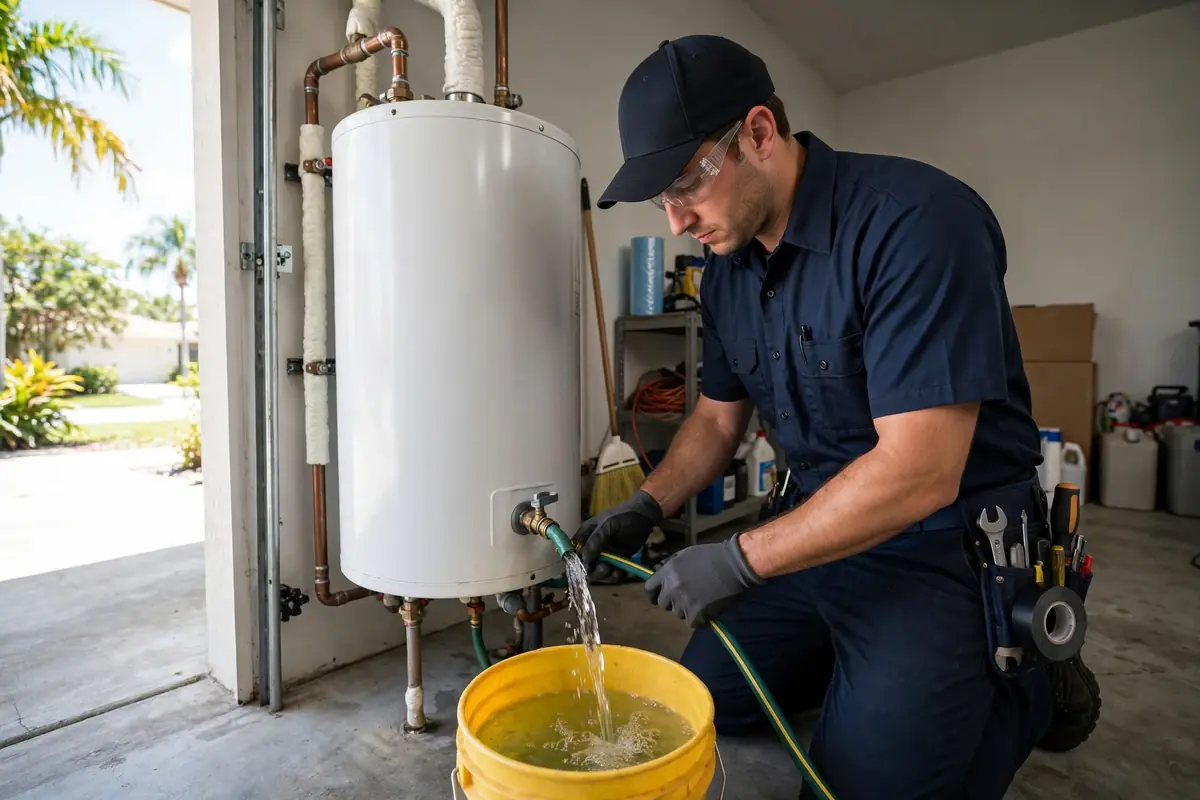
Sediment is the quiet killer of water heaters in Valrico. Our Hillsborough County water carries dissolved minerals that settle inside the tank every day, forming a layer of grit that insulates the bottom, overheats the steel, and corrodes the tank from within. The cheapest, most effective thing you can do to prevent water heater leaks is also the simplest: flush the tank regularly. This guide explains exactly how sediment turns into leaks, how often Valrico homes need flushing, and the safe step-by-step process for both electric and gas heaters.
How Sediment Turns Into Leaks
When water enters your heater, the dissolved calcium and magnesium in Florida's hard water drop out as the water heats. Those mineral particles sink to the tank bottom and bake into a sediment layer that can grow several inches thick in an unmaintained heater. That layer causes leaks through three distinct mechanisms.
First, overheating. Sediment insulates the tank bottom from the water it is supposed to heat. On a gas heater, the burner fires longer and hotter to push heat through the layer; on an electric heater, the lower element buries itself in sediment and superheats. The steel tank floor repeatedly expands and contracts under this extra thermal stress, fatiguing the glass lining until it cracks and exposes bare metal. That is how pinhole tank leaks begin.
Second, corrosion. Sediment traps moisture and chlorides against the tank steel, creating the perfect environment for localized corrosion. The anode rod — the tank's sacrificial corrosion guard — depletes faster in sediment-heavy tanks, and once it is gone, the tank wall starts dissolving. Valrico tanks on well water in areas like Lithia, Dover, and Thonotosassa face an accelerated version of this, because well water often carries iron and sulfur compounds that attack steel aggressively.
Third, component failure. Sediment clogs drain valves (the leading cause of stuck, dripping drain valves), buries heating elements until they burn out, and forces the temperature and pressure relief valve to discharge more often under overheating conditions. Each of these failures shows up as a leak — from the valve, the fittings, or the TPR discharge line — even while the tank itself is still sound.
How Often Should Valrico Homes Flush?
The national guidance says once a year. For Valrico, that is not enough. Here is the schedule that matches our local water:
- City water (Hillsborough County utility, serving most of Valrico, Brandon, Riverview, Bloomingdale): flush twice a year — spring and fall. This water is moderately hard, and six months of accumulation is enough to matter.
- Well water (common in Lithia, Dover, Thonotosassa, Wimauma, and parts of Fish Hawk): flush quarterly, and consider a whole-home sediment filter. Well water sediment loads can be three to five times higher than city water, with iron sediment that is especially corrosive.
- Homes with softeners: you can often stretch to once a year, but still flush — softeners reduce scale but do not eliminate sediment entirely.
- After any water main work or pressure event: flush once. Stirred-up mains send a slug of sediment straight into your tank.
If you have never flushed your heater and it is over five years old, read the section below on older tanks before you start — a first flush on a neglected old tank needs a more careful approach.
How to Flush an Electric Water Heater
Turn off power first — this is the single most important safety step. At your breaker panel, switch off the double-pole breaker labeled for the water heater. Heating elements that fire in a drained tank burn out in seconds, and that mistake costs an element replacement on top of everything else.
Next, shut off the cold water supply to the heater. The shutoff is usually a ball valve on the cold inlet pipe above the tank. Then open a hot water faucet somewhere in the house — a laundry tub or bathtub is ideal — to let air into the system so the tank drains freely.
Attach a garden hose to the drain valve at the tank's base and run it to a floor drain, sump, or outside where hot water will not scald plants or people. Open the drain valve slowly. The first water out may be discolored, rusty, or gritty — that is the sediment you are removing, and it is normal. Let the tank drain fully, which takes 20 to 40 minutes for a 40- or 50-gallon tank.
Once drained, open the cold supply valve briefly with the drain still open — the incoming water stirs up remaining sediment and flushes it out. Repeat two or three times until the discharge runs clear. Close the drain valve, remove the hose, close the hot faucet, and refill the tank completely before restoring power. Confirm water flows steadily from the faucet with no sputtering — air pockets in the tank can damage elements — then flip the breaker back on.
How to Flush a Gas Water Heater
The process is nearly identical, except you turn the gas control valve to the "pilot" or "off" position instead of flipping a breaker. Setting it to "pilot" keeps the pilot lit and shortens the restart; turning it fully off is the more conservative choice if you are unsure. Never relight a pilot if you smell gas — leave the house and call for help.
Shut the cold supply, open a hot faucet, hose to the drain valve, drain fully, stir-flush with brief cold water bursts until clear, then close everything and refill. Before turning the gas control back to "on" and relighting, the tank must be completely full — an empty tank fired by a gas burner can overheat and damage the tank in minutes.
While you are at it, this is a good moment to test the TPR valve: lift its lever briefly with a bucket under the discharge pipe. It should release a burst of water and snap shut. If it dribbles afterward or nothing comes out, the valve needs replacement — a separate job worth scheduling with a professional maintenance visit.
The Old Neglected Tank Problem
Here is the honest warning most guides skip: if your water heater has never been flushed and is eight or more years old, a full flush can sometimes trigger the very leak you are trying to prevent. Thick, hardened sediment may be the only thing sealing micro-cracks in an already-corroded tank bottom. Draining the tank removes that structural sediment and changes the tank's stress pattern, and a tank that was quietly failing can start weeping within days.
This does not mean you should avoid flushing old tanks forever — it means you should change tactics. Instead of a full drain, do partial flushes: drain only a few gallons through the drain valve every month or two. This removes loose sediment gradually without the full thermal and mechanical shock of a complete drain. If the water coming out runs rusty for a long time, or you see flakes of rusted metal, that tank is telling you its time is short. Call for a leak assessment rather than forcing a full flush, and start planning for replacement before it fails on its own schedule.
A professional can inspect the anode rod during the same visit. If the rod is down to a bare wire or coated in calcium, replacing it buys a struggling tank real time — sometimes years.
Tankless Heaters Need Flushing Too
Tankless owners often assume no tank means no flushing. Wrong — tankless units need descaling even more urgently in Valrico's hard water. Mineral scale coats the heat exchanger's narrow passages, reducing efficiency and eventually cracking the exchanger from thermal stress. A tankless descaling flush uses a pump to circulate vinegar or a descaling solution through the unit's service valves for 45 to 60 minutes.
Tankless manufacturers typically require annual descaling to keep the warranty valid, and in our water, twice a year is the safer interval. Unlike tank flushing, this is usually a job for a professional — the service valves, pump setup, and solution handling are more involved. It is also typically bundled with our maintenance service, which makes it easy to stay on schedule.
Valrico Water: City vs. Well
Most of Valrico, Brandon, Riverview, and Bloomingdale runs on Hillsborough County public water — treated surface and groundwater blends that are moderately hard and chlorinated. It leaves scale at a steady, predictable rate, which is why the twice-yearly flush schedule works for most city-water homes in the area.
Well water tells a different story. Homes in Lithia, Dover, Plant City outskirts, Thonotosassa, and Wimauma often run on private wells with no treatment, and that water can carry iron, sulfur, and much higher dissolved solids. Iron sediment is the worst kind — it accelerates corrosion, stains everything it touches, and eats anode rods at double speed. If you are on well water, quarterly flushing plus a sediment pre-filter and an anode rod inspection every two years is the minimum. Many well-water homeowners in eastern Hillsborough County also add water softeners or iron filters, which transform the flushing math entirely.
Not sure what you have? Check your water bill — a Hillsborough County water bill means city water. No bill and a wellhead in the yard means well water. When in doubt, ask us during a service visit and we will tailor the schedule to your water.
Due for a Flush in Valrico?
Sediment flushing, anode rod checks, and full maintenance — one visit covers it all. Call Water Heater Leak Repair Works for a free estimate.
Frequently Asked Questions
How often should I flush my water heater in Valrico?
Twice a year for city water homes, quarterly for well water homes. Valrico's hard water builds sediment faster than the national once-a-year guidance assumes, and well water in Lithia and Dover builds it fastest of all.
Can I flush my water heater myself?
Yes — it is a safe DIY job if you follow the steps: power or gas off, cold supply off, hose on the drain valve, drain fully, stir-flush until clear, refill completely before restoring power or gas. If the drain valve is stuck or corroded, stop and call a professional rather than forcing it.
Will flushing an old water heater cause it to leak?
It can, on tanks over eight years old that have never been flushed — hardened sediment may be sealing existing weak spots. Use gentle partial flushes on neglected old tanks, and have the anode rod and tank condition assessed before a full drain.
What does it mean if the flush water is rusty?
Some initial discoloration is normal sediment. If the water stays rusty after several stir-flush cycles, or you see rust flakes, the tank interior is corroding — that is an end-of-life signal, not just dirt.
Do tankless water heaters need flushing?
Yes — descaling once or twice a year. Hard water scale narrows the heat exchanger passages and can crack the exchanger. Tankless descaling is usually done by a professional with a pump and descaling solution.
Should I flush after a boil-water notice or main break?
Yes. Pressure events and main repairs stir sediment into the supply lines, and your tank catches it. One extra flush after the event keeps that slug of grit from settling in for the long term.