Published: 2026-10-10
Tank vs Tankless Water Heater Leaks Compared
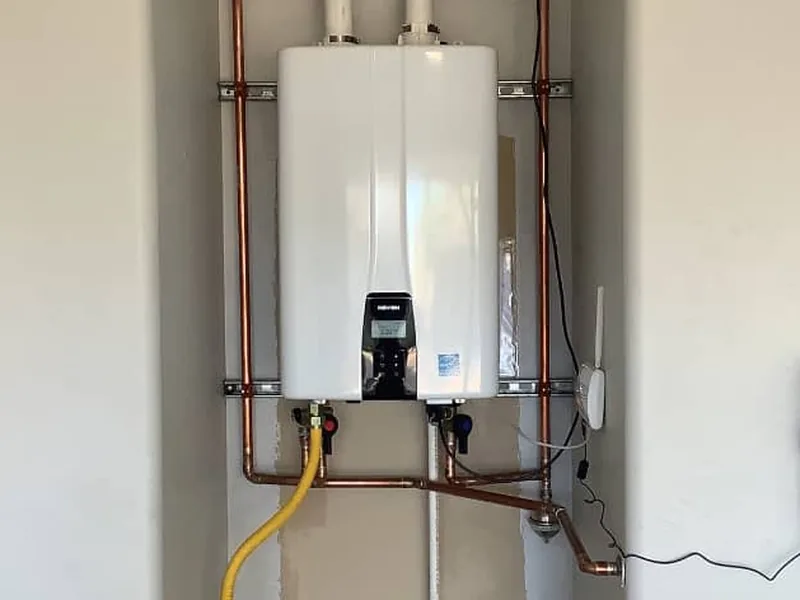
When homeowners compare tank and tankless water heaters, the conversation usually centers on energy use, endless hot water, and upfront cost. Leaks rarely enter the discussion — until one happens. But the two designs fail in fundamentally different ways, and understanding those differences matters twice: when you are choosing a system, and when you are diagnosing a wet spot and need to know how worried to be.
A tank heater holds 40–80 gallons under pressure around the clock; when it fails, it fails wet — sometimes very wet. A tankless unit holds only a small volume of water in its heat exchanger at any moment; its leaks are typically smaller but trickier to find. Here is how the failure modes compare, in plain terms.
How Tank Heaters Leak
The defining risk of a tank heater is the tank itself. Decades of heat cycling, sediment, and corrosion thin the steel until pinholes form — usually at the base or along welds — and eventually the tank ruptures. A ruptured tank releases its full contents plus incoming supply water until someone shuts it off. This is the catastrophic water heater flood, and it is unique to tank designs.
Tank heaters also leak from their many fittings: inlet and outlet connections, the TPR valve, the drain valve, the anode rod port, and heating element gaskets on electric models. These fitting leaks are the common, repairable kind — annoying but manageable, and usually inexpensive to fix. The pattern is simple: fitting leaks are repairs, tank-body leaks are replacements.
How Tankless Heaters Leak
Tankless units cannot rupture a tank — there is no tank. Their leaks come from:
- Heat exchanger failure. The copper or stainless heat exchanger is the tankless equivalent of the tank — mineral scale and thermal stress can crack it. A cracked exchanger leaks inside the unit and is usually the most expensive tankless repair.
- Fitting and connection leaks. Water, gas, and condensate connections all have seals that age. These are the most common tankless leaks and the most repairable.
- Condensate drain problems. High-efficiency condensing units produce acidic condensate that must drain away. A clogged or disconnected condensate line backs water up into and around the unit.
- Pressure relief valve discharge. Tankless units have their own relief valves; discharge indicates pressure or temperature problems similar to tank systems.
- Freeze damage. Rare in Valrico but not impossible during hard cold snaps — units in exposed locations can crack if their freeze protection fails during a power outage.
The good news: a tankless leak's maximum damage is bounded by flow rate, not by 50 stored gallons. The bad news: leaks inside the sealed unit are harder for homeowners to spot early.
Side-by-Side Comparison
Worst-case water damage: Tank heaters win this contest decisively — a ruptured tank floods. Tankless worst cases are slow seeps from the heat exchanger or a failed fitting.
Leak frequency: Roughly comparable over the equipment's life. Tank heaters leak more often from fittings simply because they have more of them and operate under constant stored pressure; tankless units leak less often but their heat exchanger failures are pricier.
Detectability: Tank leaks announce themselves — puddles, rust, noise. Tankless leaks hide inside wall-mounted cabinets; by the time water appears below the unit, it may have been seeping for weeks. Leak alarms are arguably more valuable with tankless.
Repair cost profile: Tank fitting repairs are usually straightforward and modest. Tank-body failure means full replacement. Tankless fitting repairs are similar in scope; heat exchanger replacement can approach the cost of a new unit.
Lifespan context: Tanks typically last 8–12 years in Florida conditions; tankless units 15–20 with proper descaling. A tankless unit's longer life means more years of leak-free service, but it also means its eventual heat exchanger failure arrives on an older unit where replacement makes more sense than repair.
What This Means for Valrico Homeowners
If you have a tank heater — as most Valrico homes do — your prevention priorities are sediment flushing, anode rod replacement, and a drain pan with a leak alarm, because your catastrophic scenario is a tank rupture. If you have or are considering tankless, your priorities shift to annual descaling flushes (non-negotiable in this hard water), condensate drain maintenance, and periodic professional inspection of the heat exchanger and connections. Our tankless water heater repair service covers diagnosis and repair of unit-specific failures.
Thinking of switching? A tankless conversion eliminates rupture risk and frees floor space, but it demands committed descaling maintenance in Florida water and a larger upfront investment. A new high-efficiency tank with diligent maintenance remains a rational, lower-cost choice for many homes. Either way, the decision should follow an honest assessment of your water quality, usage, and the condition of your current unit — which is exactly what our water heater installation consultations provide.
Leak Volume Compared: 50 Gallons vs. a Slow Seep
The most important difference between tank and tankless leaks is not whether they leak — both can — but how much water escapes when they do. A conventional tank heater holds 40 to 50 gallons, and when the tank wall fails, a large portion of that volume can empty onto your floor in minutes, with the supply line continuing to feed the flood until someone shuts it off. In a Valrico garage, that is a mess; in an attic or interior closet, it is a ceiling collapse and a major insurance claim.
Tankless units hold only a cup or two of water in the heat exchanger at any moment. When they leak — from a cracked exchanger, a failed fitting, or a condensate issue — the water escapes as a seep or drip, fed only by the supply line. The damage potential per incident is dramatically lower. There is no 50-gallon reservoir waiting to empty.
This does not make tankless leak-proof, and it does not make tank heaters reckless — millions of tank heaters serve reliably with a drain pan and a leak alarm. But for heaters located where a leak would be catastrophic — attics, second-floor closets, above finished living space — the tankless failure mode is inherently more forgiving. When we advise Fish Hawk or Riverview homeowners with attic heaters, leak consequence is part of the conversation alongside efficiency and upfront cost.
Which Is Cheaper to Fix When It Leaks?
Repair economics flip depending on what fails. For tank heaters, component leaks are cheap: a drain valve, a TPR valve, an element gasket, a fitting — all modest parts with straightforward labor. But a tank-wall leak is not a repair at all; it is a full replacement, because tanks cannot be patched. The most common catastrophic tank failure is also the most expensive outcome.
Tankless repairs run the other direction. There is no tank to replace, but the parts that do fail — the heat exchanger, the control board, the gas valve assembly — are expensive components, and the labor requires a technician experienced with the specific brand. A cracked heat exchanger on an out-of-warranty tankless unit can cost a substantial fraction of a new unit, which forces the same repair-versus-replace calculation tank owners face, just at higher part prices.
The maintenance factor decides the real-world winner. A maintained tank heater in Valrico reliably serves 10 to 12 years with only minor component repairs. A descaled tankless unit serves 15 to 20. A neglected tankless in our hard water, though, can need a heat exchanger years early — the most expensive single failure in residential water heating. Whatever type you own, the maintenance schedule in our maintenance checklist is what keeps repair costs in the minor column.
Choosing for a Valrico Home: Leak Risk as a Decision Factor
When Valrico homeowners choose between tank and tankless, efficiency and endless hot water dominate the discussion — but leak risk deserves a seat at the table, because our local conditions affect the two types differently. Hard water punishes both: it sediments tank bottoms and scales tankless exchangers. The difference is that tank sediment is managed with a free twice-yearly flush, while tankless scale requires professional descaling with a pump and solution — a real ongoing cost that tankless owners must budget.
Installation location should influence the choice. Attic and interior-closet heaters — where leak consequences are severe — favor tankless for the smaller failure volume, provided the owner commits to descaling. Garage installations, where a leak is a mop-up rather than a renovation, keep the economic advantage with tank heaters: lower upfront cost, cheaper parts, simpler service, and any qualified technician can work on them.
Household size matters too. Large families in Riverview or Fish Hawk who would need two tankless units for adequate flow may find the leak-risk and cost math favors a single large tank or a hybrid approach. There is no universally right answer — only the right answer for your water, your heater location, your household, and your willingness to maintain the equipment. That is exactly what our replacement consultations work through, so the decision is made on your home's facts rather than marketing.
Tank or Tankless — Leak Trouble Either Way?
Water Heater Leak Repair Works services both tank and tankless systems across Valrico. Call for a free estimate and straight answers.
Frequently Asked Questions
Can a tankless water heater flood my house?
Not the way a ruptured tank can — there is no stored volume to release. Tankless leaks are limited to the flow through the failed component, which is still capable of serious damage over time but not a sudden 50-gallon flood.
Which type leaks more often?
Tank heaters generate more leak service calls, largely because there are far more of them in service and their fitting leaks are highly visible. Per unit, a maintained tankless leaks less often but costs more when its heat exchanger fails.
Do tankless heaters need drain pans?
They benefit from leak protection even more than tanks in one sense — their leaks are harder to spot. A pan or leak alarm under a wall-mounted unit catches seeps before they damage the wall behind it.
Is hard water worse for tank or tankless heaters?
Both suffer, differently. Tanks accumulate sediment that stresses the tank bottom; tankless units scale their narrow heat exchanger passages, choking efficiency. Tankless units arguably need more disciplined water treatment because there is no flushing a heat exchanger clean the way you flush a tank.
If my tankless heat exchanger cracks, should I repair or replace?
On a unit under ten years old, exchanger replacement can make sense. On an older unit, the repair cost relative to a new unit with a fresh warranty usually favors replacement.