Published: 2026-10-10
Tankless Water Heater Leak Causes Explained
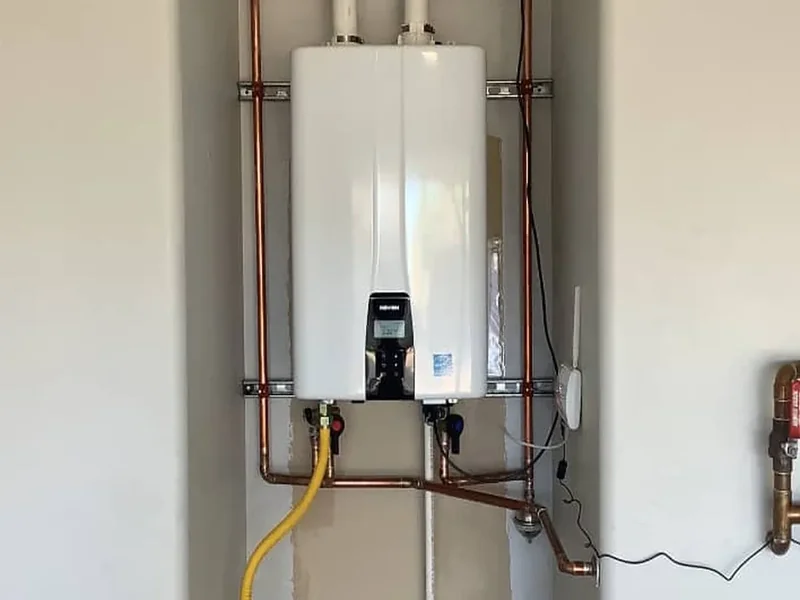
Tankless water heaters have a reputation for reliability — no tank to rust through, no 50 gallons waiting to flood the garage. That reputation is mostly earned, but tankless units do leak, and their leaks confuse homeowners precisely because they do not match the tank-leak playbook. Water appears below a wall-mounted box with no puddle source you can see, or the unit throws an error code while the floor stays dry.
This guide covers where tankless leaks actually come from, how Florida conditions contribute, and how to respond — from the five-minute checks you can do to the failures that need a technician.
The Heat Exchanger: The Big One
The heat exchanger is the heart of a tankless unit — a coiled maze of copper or stainless tubing where cold water flashes to hot in seconds. It endures extreme thermal cycling: cold water slamming into superheated metal, thousands of times a day. Over years, this cycling stresses the metal, and in hard-water areas, mineral scale adds a destructive twist. Scale insulates spots on the exchanger walls, creating hot spots where the metal overheats, weakens, and eventually cracks or pinholes.
A cracked heat exchanger leaks inside the unit's cabinet. You may see water dripping from the bottom of the unit, error codes related to overheating or flow, or reduced hot water output as the unit struggles. Exchanger failure is the most expensive tankless repair — on older units, it often tips the decision toward replacement. Regular descaling is the prevention; in Valrico water, it is not optional.
Fittings, Seals, and Connections
More common and far less dire are leaks at connection points. A tankless unit has water inlet and outlet connections, a gas connection, and — on condensing models — a condensate drain. Each has seals, gaskets, or threaded joints that age:
- Water connections weep from worn gaskets or loosened fittings, especially after years of thermal expansion cycling.
- The pressure relief valve can drip from pressure spikes or valve wear, exactly as on tank systems.
- Internal O-rings harden with heat and time, seeping inside the cabinet where you cannot see them until water exits the bottom.
- Service valves (the isolation valves installed for flushing) develop drips at their stems — ironic, since they exist for maintenance.
These are the tankless equivalent of tank fitting leaks: repairable, usually modest in scope, and caught early. Any persistent moisture below the unit deserves a look from our tankless water heater repair team before a weep becomes a stream.
Condensate Drain Failures
High-efficiency condensing tankless units extract extra heat from exhaust gases, which produces acidic condensate — water that must drain away through a dedicated line. When that line clogs with debris or algae (common in Florida's warm, humid conditions), disconnects, or was improperly routed without a neutralizer, condensate backs up. It can pool inside the unit, corrode components, and leak from the cabinet bottom.
Symptoms of condensate trouble include water beneath the unit with no error code, gurgling sounds, or visible blockage at the drain termination. The fix is usually simple — clear the line, verify proper slope and termination — but the acidic condensate's corrosive nature means prolonged backups damage more than they should. Annual service should always include a condensate line check.
Scale: The Florida Accelerant
Valrico's hard water is the thread connecting most tankless leak causes. Scale narrows the heat exchanger's passages, forcing the unit to fire harder and hotter to deliver the same output. Hotter firing means more thermal stress on already-scaled metal — the exact recipe for exchanger cracks. Scale also damages flow sensors and valves, causing the erratic behavior that stresses seals.
The defense is a descaling flush — circulating a descaling solution through the unit via its service valves — performed annually in hard-water areas, sometimes twice a year for very hard well water. Units installed without service valves make this job much harder, which is why proper installation includes them. A water softener upstream of the unit is the longer-term answer for Valrico homes. Skipping descaling does not just risk leaks; it voids many manufacturer warranties, which explicitly require it in hard-water regions.
What to Do When You Find Tankless Leaking
First, determine whether the water is from the unit or its surroundings — condensation on cold-water piping in a humid garage fools many owners. Dry everything, run hot water, and watch. If the unit itself is the source: shut off water to the unit via its isolation valves, turn off power (breaker) or gas, and note any error codes on the display — they are diagnostic gold for the technician. Do not open the cabinet yourself; internal components include high-voltage ignition parts and gas connections.
Then call. Tankless diagnosis rewards expertise — the difference between a failed O-ring and a cracked exchanger is not visible from outside, and the repair paths diverge sharply in cost. Regular water heater maintenance that includes descaling, condensate checks, and connection inspection prevents most tankless leaks before they start.
Condensate Drain Failures in High-Efficiency Units
Condensing tankless water heaters — the high-efficiency models — produce acidic condensate as a byproduct of wringing extra heat from exhaust gases. That condensate has to drain somewhere, and the drain system is a leak source that surprises owners. The condensate line can clog with mineral deposits and debris, the neutralizer cartridge (which treats the acidity before discharge) can saturate, and the drain connection at the unit can loosen.
When the condensate path blocks, water backs up and finds its own way out — dripping from the unit's base or from joints in the drain line. Homeowners often assume the heat exchanger has failed, but the fix is usually clearing the line and servicing the neutralizer. The telltale sign is water that appears only when the unit has been running hard, and a drain line that feels cool and looks discolored at the blockage.
Prevention is simple: include the condensate line and neutralizer in annual service. The neutralizer media depletes and needs periodic replacement — a cheap part that protects both your drain plumbing (acidic condensate eats cast iron and copper over time) and the area around the unit. If your condensing tankless sits in a Valrico garage with the condensate line running to a floor drain, make sure that drain itself is clear; a backed-up floor drain turns a condensate drip into standing water.
Freeze Damage: Florida's Surprise Tankless Killer
It does not freeze often in Valrico, but when it does, tankless heaters are uniquely vulnerable. A tank heater holds 50 gallons of thermal mass that resists freezing for hours; a tankless heat exchanger holds a cup of water in thin copper passages that freeze fast. The expanding ice cracks the exchanger, and the leak appears when everything thaws — often days after the cold snap, which obscures the cause.
Exterior-mounted units and garage installations with louvered ventilation are the most exposed. Most modern tankless units have built-in freeze protection — electric heaters that warm the exchanger — but they only work when the unit has power. A power outage during a freeze, which is exactly when Florida cold snaps often strike, disables the protection at the moment it is needed.
The defense is layered. Keep the unit powered during freezes (do not switch off that breaker to "save energy" in January). For exterior units, an insulated cover helps. If an extended hard freeze with outage risk is forecast, the safest move is draining the unit per the manufacturer's procedure — the service valves installed for descaling make this a quick job. And after any freeze where the unit lost power, inspect for weeping at the exchanger before assuming all is well; freeze cracks start as seeps and grow.
Service Valves and Descaling Ports: Common Drip Points
Tankless units have more connection points than tank heaters — isolation valves, service valves for descaling, pressure relief, gas, condensate — and every connection is a potential drip. The service valves deserve special attention because they are touched during every descaling: the caps and seals wear, threads get crossed by hurried hands, and a valve left slightly open after service weeps for months.
After any descaling service, verify: service valve caps snug, isolation valves fully open (a half-open isolation valve whistles and stresses the system), and no moisture at any of the touched connections. A paper towel wiped around each joint comes away dry on a good job. If you notice dripping after a service visit, call back promptly — it is almost always a quick correction, and reputable providers fix their own service drips without charge.
The isolation valves themselves age like any valve: washers harden, stems weep. During annual service, exercise them — close and reopen fully — to prevent seizing, and replace any that weep from the stem. These are small, cheap components, but a failed isolation valve can force a full system drain to replace, so catching the weep early matters. Include a connection-by-connection moisture check in your annual routine, or make sure your maintenance visit does — tankless leak prevention is mostly about the fittings, not the exchanger.
Tankless Unit Leaking in Valrico?
Heat exchanger issues, fitting leaks, condensate problems — Water Heater Leak Repair Works diagnoses and repairs tankless systems. Call for a free estimate.
Frequently Asked Questions
How often should a tankless water heater be descaled in Florida?
At least annually; twice a year for homes on hard well water. Valrico's mineral content makes this the single most important tankless maintenance task, and many warranties require it.
Why is there water under my tankless unit but no error code?
Likely culprits are a condensate drain backup, a weeping fitting, or condensation on piping — none of which necessarily trigger error codes. Dry the area, run the unit, and observe where fresh moisture appears.
Can I descale my tankless unit myself?
With installed service valves, a pump, and descaling solution, experienced DIYers do it. But improper procedure can damage the unit, and professional service includes inspection of the exchanger, sensors, and condensate system in the same visit.
Does a water softener help a tankless heater?
Enormously. Softened water dramatically slows heat exchanger scaling — the primary driver of tankless leaks and efficiency loss in hard-water areas. It is the strongest long-term protection for the unit.
My tankless unit is leaking from inside the cabinet. How bad is that?
It needs professional diagnosis promptly. Internal leaks can come from a minor O-ring or a cracked heat exchanger — the cost difference is large, and only an internal inspection distinguishes them. Shut the unit down and call.