Published: 2026-10-12
High Water Pressure and Water Heater Leak Risk
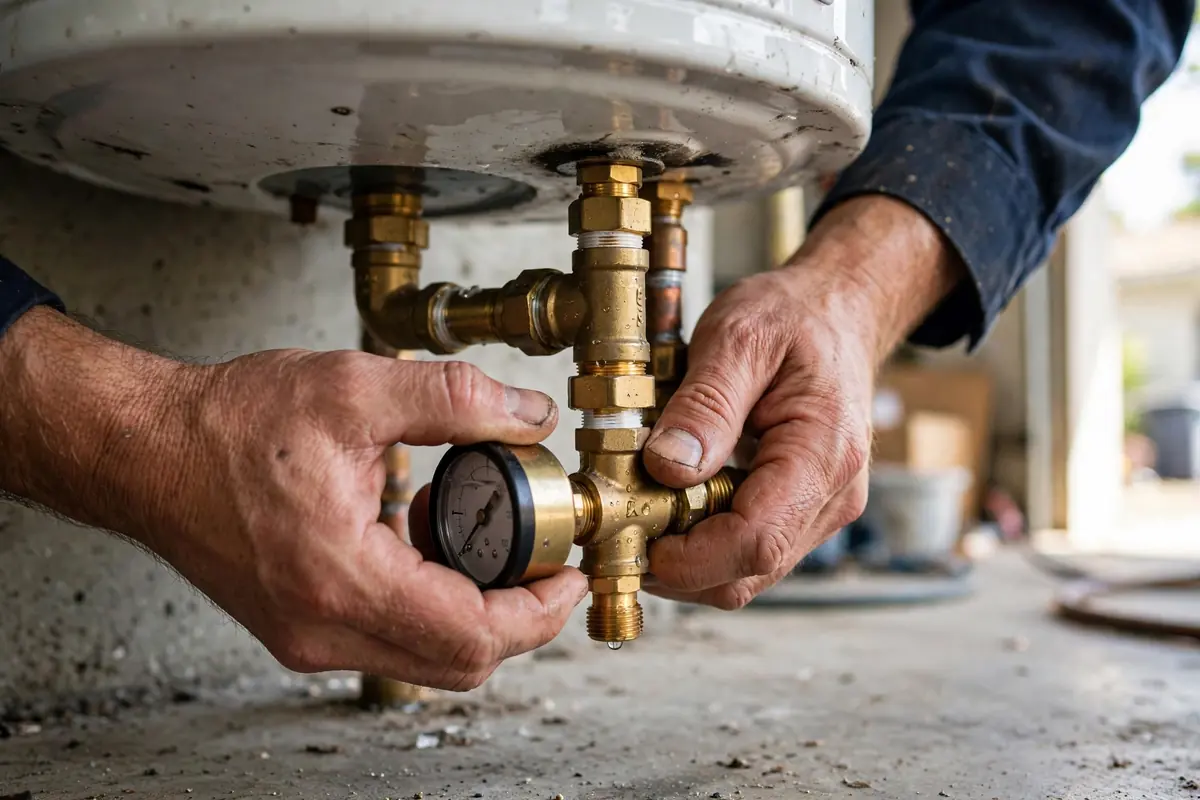
Most homeowners never think about their water pressure — until something starts leaking. Excess pressure is one of the most overlooked causes of water heater leaks in Valrico: it hammers the tank with every heating cycle, forces safety valves to weep, and shortens the life of every fitting in the system. The good news is that pressure problems are cheap to diagnose and straightforward to fix. Here is how to tell if your pressure is too high, why it threatens your heater, and what to do about it.
What Counts as High Water Pressure?
Residential water pressure is measured in PSI — pounds per square inch. The comfortable, safe range for a home is 40 to 60 PSI. The plumbing code maximum for residential systems is 80 PSI; anything above that is officially too high and requires a pressure-reducing valve.
In practice, the danger zone starts lower than many people think. Sustained pressure in the 70s accelerates wear on water heaters, washing machine hoses, toilet fill valves, and faucet cartridges. Pressure above 80 does not just accelerate wear — it actively damages. And pressure is not constant: municipal supply pressure rises at night when neighborhood demand drops, so a home reading 75 PSI at noon can spike well above 80 at 3 a.m. That overnight spike is when TPR valves do their mysterious middle-of-the-night weeping.
Valrico homes see a wide range. Houses close to municipal supply infrastructure or at lower elevations relative to the water source tend to run higher. Newer developments in Riverview and Fish Hawk with modern pressure regulation usually sit in the safe band — but older neighborhoods in Brandon and Bloomingdale, where original regulators have aged out, are where we find the 90-plus readings.
How High Pressure Causes Water Heater Leaks
A water heater is a sealed steel pressure vessel, and pressure attacks it in several ways at once.
Thermal expansion amplification. Water expands when heated — about 4 percent in volume from cold to hot. In an open plumbing system, that extra volume pushes back into the municipal main. But most modern Valrico homes have check valves, backflow preventers, or pressure regulators that create a closed system: the expanded water has nowhere to go, so system pressure spikes with every heating cycle. Without a working expansion tank to absorb it, each cycle hammers the tank seams, fittings, and the TPR valve. Over years, this cyclic fatigue cracks glass lining and loosens joints — the classic slow leak that appears at a fitting or seam with no other explanation.
TPR valve weeping. The temperature and pressure relief valve opens at 150 PSI or 210°F. Chronic high static pressure plus thermal expansion spikes can push the valve to its setpoint repeatedly, and a valve that opens often starts to weep continuously — dripping from the discharge pipe even at normal temperatures. Many homeowners misdiagnose this as a tank leak, but it is a pressure problem wearing a leak costume.
Fitting and connection stress. Dielectric unions, flex connectors, and threaded joints all have pressure ratings. Sustained high pressure flexes these connections microscopically with every pump cycle and thermal swing, eventually loosening them into drips. The leak shows up at the top of the heater — often blamed on the tank — when the real culprit is the pressure behind it.
Water hammer. High pressure makes water hammer worse: when a valve snaps shut, the moving water column slams to a stop, sending a shock wave through the pipes. Repeated hammer loosens solder joints and pipe straps, and the tank absorbs its share of the shock. If you hear banging when the washing machine or dishwasher valves close, you have both a pressure problem and a hammer problem.
Signs Your Home Has High Water Pressure
- The TPR discharge pipe drips — the single most common pressure symptom at the heater itself.
- Toilets run or refill on their own — high pressure defeats fill valves, causing phantom flushes and constant running.
- Faucets spit or spray when first opened — air is not the only cause; pressure surges do this too.
- Banging pipes (water hammer) when appliances or faucets shut off.
- Short appliance life — washing machine hoses, dishwasher valves, and water heater components failing "early" across the house is a pressure signature, not bad luck.
- Leaking at multiple fixtures — when the heater, a toilet, and an outdoor spigot all develop drips in the same year, suspect the pressure they share.
Any two of these together justify a pressure test. A ten-dollar gauge from a hardware store, threaded onto an outdoor spigot or the water heater drain valve, gives you a static reading in seconds. For the full picture, leave the gauge on overnight — the max-needle reading shows the nighttime spike that daytime checks miss.
Closed Systems: Why Valrico Homes Need Expansion Control
Here is the part most homeowners miss: a pressure-reducing valve (PRV) at the house entry solves high incoming pressure, but it also creates a closed system — water can no longer expand back into the municipal main. Florida plumbing code recognizes this and requires thermal expansion control wherever a PRV, check valve, or backflow preventer makes the system closed. In practice, that means an expansion tank on the cold water line near the heater.
The expansion tank is a small tank with a rubber bladder: one side holds system water, the other holds a pre-charged air cushion. When heated water expands, it compresses the air cushion instead of spiking system pressure. It is a simple device doing critical work — and it fails silently. The bladder ruptures or the air charge bleeds off, and the tank becomes a dead weight on the pipe doing nothing. We check expansion tank charge on every maintenance visit because a failed one is invisible until the TPR starts weeping or a seam lets go.
Common Valrico scenario: a homeowner in Bloomingdale gets a new PRV installed to fix 95 PSI incoming pressure — correctly — but no expansion tank is added. Six months later the TPR discharge pipe is dripping and the new heater's fittings are weeping. The pressure fix created the expansion problem. The complete fix is always PRV plus expansion tank, sized and charged to match the system.
Testing and Fixing High Pressure
Test first. Thread a pressure gauge onto a hose bib or laundry faucet. Read the static pressure with no water running, then leave it for 24 hours (or at least overnight) to catch the maximum. If static pressure is above 80 PSI — or the overnight max is — you have a confirmed problem.
Install or replace the PRV. The pressure-reducing valve sits on the main water line where it enters the house, usually near the meter or in the garage. A new PRV costs far less than the damage high pressure does over a few years, and a functioning one holds the whole house in the 50–60 PSI sweet spot. PRVs last roughly 10 to 15 years; if yours is older and pressure is creeping up, the valve's spring has likely weakened. Replacement is a straightforward half-day job.
Add or service the expansion tank. With a PRV in place, an expansion tank on the cold inlet near the water heater is required by code and by physics. Sizing follows heater capacity — a 2-gallon tank suits most 40- to 50-gallon residential heaters — and the air pre-charge must match your house pressure (typically 50–60 PSI). An existing tank that has failed needs replacement; they cannot be recharged once the bladder ruptures.
Address water hammer. If hammer persists after pressure is corrected, hammer arrestors at fast-closing valves (washing machine, dishwasher) absorb the shock. Securing loose pipe straps quiets the rest.
Pressure work sits squarely in professional territory — it involves the main shutoff, correct PRV sizing, expansion tank charging, and code compliance. Our expansion tank guide goes deeper on that component, and a leak and pressure assessment covers the whole system in one visit.
New Builds vs. Older Homes in the Valrico Area
Newer construction in Riverview, Fish Hawk, and the newer phases of Bloomingdale typically arrives with a PRV and expansion tank installed to current code — pressure problems there usually mean a component has aged out, not that one was never installed. The fix is replacement and recharging, not new design.
Older homes — 1980s and 1990s builds common across Brandon, Valrico proper, and Seffner — are the wild cards. Some have PRVs that failed a decade ago without anyone noticing; some never had expansion control added when a check valve went in; some run straight off high municipal pressure with nothing at all. These homes benefit most from a full pressure audit: static and overnight readings, PRV condition check, expansion tank test, and a look at the heater's fittings for pressure-fatigue weeping. It is a one-hour assessment that can add years to a water heater's life.
Worried About Your Water Pressure?
We test static and overnight pressure, check your PRV and expansion tank, and fix what is wrong — protecting your heater and your whole plumbing system. Call Water Heater Leak Repair Works in Valrico.
Frequently Asked Questions
What is normal water pressure for a house in Valrico?
40 to 60 PSI is the ideal range. The plumbing code maximum is 80 PSI — anything above that requires a pressure-reducing valve. Many Valrico-area homes run in the 70s or higher without the homeowner knowing.
Can high water pressure cause my water heater to leak?
Yes — it is a leading overlooked cause. High pressure amplifies thermal expansion stress on tank seams, makes the TPR valve weep, loosens fittings, and worsens water hammer. Chronic pressure above 80 PSI measurably shortens heater life.
Why does my TPR valve only drip at night?
Municipal pressure rises overnight when neighborhood demand drops. If your daytime pressure is already in the 70s, the nighttime spike can push the system past the TPR setpoint — classic sign of a pressure problem, often combined with a failed expansion tank.
Do I need an expansion tank if I have a pressure-reducing valve?
Yes — a PRV creates a closed system, and Florida plumbing code requires thermal expansion control on closed systems. Without an expansion tank, every heating cycle spikes system pressure against the tank and fittings.
How do I test my home's water pressure?
Thread a pressure gauge onto an outdoor hose bib or the water heater's drain valve. Check the static reading, then leave it overnight — the max reading reveals nighttime spikes that daytime checks miss.
How long does a pressure-reducing valve last?
Roughly 10 to 15 years. If your home's pressure is creeping up and the PRV is older than that, the valve's spring has likely weakened and replacement is due — a straightforward job that protects every fixture in the house.