Published: 2026-10-10
Water Heater Replacement vs Repair: How to Decide
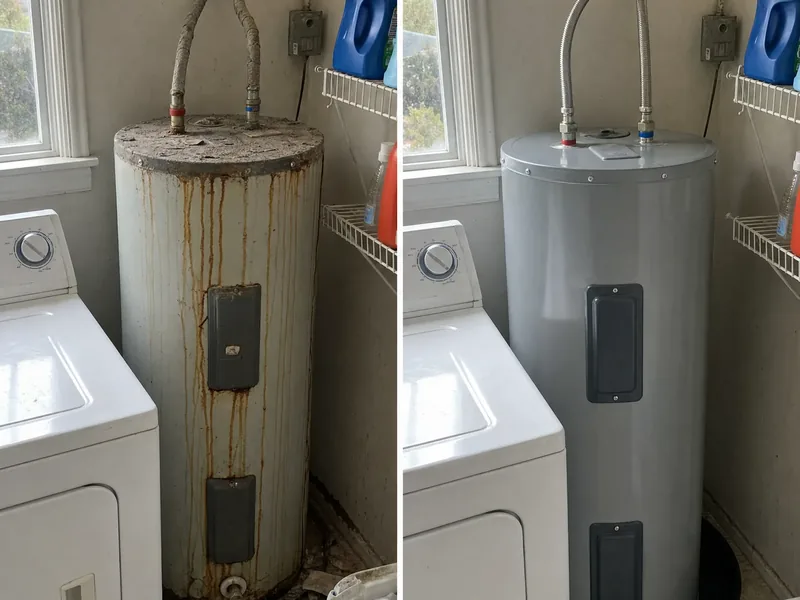
Your water heater is acting up — again. The question hanging over every service call on an aging heater: repair it or replace it? Repair is cheaper today; replacement is cheaper if the repair only buys months. The wrong choice wastes money either way — a new heater when a valve would have done, or a valve when the tank fails six months later.
This guide gives you the decision framework technicians use: the factors that favor repair, the ones that demand replacement, and the gray zone where judgment — and an honest assessment — matters most.
When Repair Is the Clear Answer
Repair confidently when all of these are true:
- The tank itself is sound. No leaks from the tank body, no rust streaks from seams, no moisture at the base. The tank is the heater; everything else is accessories.
- The heater is under 8 years old. Plenty of service life remains to amortize the repair.
- The failure is isolated. A bad element, a failed thermostat, a dripping valve, a worn TPR — single-component failures on an otherwise healthy heater.
- This is the first significant problem. No pattern of cascading failures suggesting systemic decline.
- Performance is otherwise good. Recovery time, capacity, and efficiency are all normal.
A five-year-old heater with a failed heating element is a textbook repair. The tank has years left; the part is straightforward; move on.
When Replacement Is the Clear Answer
Replace without deliberation when:
- The tank body leaks. Water from the tank walls, seams, or base means the steel has failed. No repair restores a rusted-through tank.
- The heater is past 12 years (tank) and needs anything beyond trivial service. The remaining life does not justify the investment.
- Repairs are becoming frequent. Elements, then the thermostat, then a valve — each fix is rational alone, but the pattern says the heater is in systemic decline.
- Efficiency has collapsed. Heavy, unflushable sediment means permanently degraded performance — you are paying extra energy for reduced hot water.
- Safety components are compromised along with age. A failing gas valve or chronic overheating on an old heater is not worth nursing along.
The Gray Zone: 8–12 Years With a Repairable Problem
This is where most real decisions live. A nine-year-old heater with a failed valve: repair or replace? Consider:
Overall condition. Is the tank clean and dry, the anode rod recently replaced, sediment under control? A well-maintained nine-year-old can run several more years — repair makes sense. A neglected nine-year-old with rust streaks and heavy sediment is a different story.
Repair scope relative to replacement. A single valve on a decent nine-year-old: repair. A gas valve plus a TPR valve plus an expansion tank on a ten-year-old: you are stacking costs on borrowed time — replacement starts looking rational.
Your plans for the home. Selling within a year or two? A working repair may suffice. Staying long-term? A new heater's warranty and efficiency pay back over the years you will actually use it.
Water quality trajectory. In Valrico's hard water, an aging tank faces accelerating decline — scale and corrosion do not pause. The gray zone is narrower here than in soft-water regions.
Opportunity timing. If replacement is likely within two years anyway, doing it now — on your schedule, with time to choose the right unit — beats doing it during the next failure's emergency.
What Replacement Gets You (Beyond a Working Heater)
A new heater is not just a repair that lasts longer. Current models are more efficient than decade-old units — meaningful in Florida where heaters work year-round. You get a fresh full warranty instead of none. Installation brings the setup up to current code: expansion tank, proper venting, drain pan, strapping — the safety and longevity items older installs often lack. And you can reconsider the type: fuel switching, upsizing or downsizing, or going tankless, evaluated calmly rather than under crisis pressure. Our water heater installation consultations walk through these options without sales pressure.
Getting an Honest Assessment
The repair-vs-replace question is where contractor incentives matter — some companies push replacement for the bigger ticket, others push repairs to win the call. Protect yourself with specifics: ask for the tank's condition assessment (not just the failed part), the heater's age from the serial number, and both options with itemized numbers where both are viable. A trustworthy technician explains the reasoning, not just the recommendation. If the tank is sound and young, we will tell you to repair it — our water heater leak repair service fixes what is fixable, and we say so when replacement is the honest answer too.
The Age-Efficiency Math: Running the Numbers
The repair-versus-replace decision has a financial dimension beyond the repair quote: the aging heater's operating cost. Water heaters lose efficiency as they age — scale insulates heating surfaces, sediment forces longer cycles, and worn components work harder. A 12-year-old electric tank in Valrico's hard water can easily cost 15 to 25 percent more to run than it did new, and that premium compounds every month on a Florida electric bill that never takes a season off.
New units add a second efficiency gain: standards have tightened. A current-model tank heater is measurably more efficient than a decade-old one, and the gap widens if you consider switching technologies — heat pump hybrids cut water heating energy dramatically in our warm climate, where they operate at peak efficiency. When the repair quote lands on your aging heater, add the annual operating-cost difference over the new unit's expected life to the replacement side of the ledger.
The math that often surprises homeowners: a $500 repair on a 12-year-old inefficient heater versus replacement with a modern efficient unit. The repair buys maybe two more years of high operating costs; the replacement resets both the repair clock and the efficiency baseline for a decade. Run the numbers with your actual electric rate and household usage — for high-use families in Riverview or Fish Hawk, the efficiency savings alone can tilt a borderline decision firmly toward replacement.
Code Upgrades That Come With Replacement in Florida
Replacing a water heater in Florida is not a straight swap — current code applies to the new installation, and older Valrico homes often lack items the code now requires. Budget for these rather than being surprised by them. The common additions: a thermal expansion tank on closed systems (required, and most older homes do not have one), a drain pan with a drain line where the heater sits over finished space or in an attic, updated venting for gas units to current standards, and a pressure-reducing valve check with correction if house pressure exceeds 80 PSI.
Electrical and gas connections get modernized too: dedicated circuits verified for electric units, gas connectors replaced (reusing a decade-old gas connector is false economy), and seismic strapping where applicable. Permits and inspection are part of a proper replacement — Florida jurisdictions generally require a permit for water heater replacement, and the inspection protects you by verifying the code items were actually done.
These additions are not upsells; they are the code-compliant installation your old heater predates. When comparing replacement quotes, verify each one includes the same code items — a quote that omits the expansion tank and permit is not cheaper, it is incomplete. The installed-to-code heater also protects your warranty coverage, since manufacturers can void warranties over code violations in the installation.
Timing Your Replacement: Avoiding the Emergency Premium
The cheapest replacement is the planned one, and the price difference between planned and emergency replacement is substantial. Emergency replacements carry after-hours labor premiums, rushed equipment sourcing (you get whatever is in stock, not the best unit for your home), and the water damage repair that prompted the emergency in the first place. A planned replacement happens on a weekday morning with the unit you chose, installed to code, at standard rates.
The planning window opens around year eight for a tank heater in Valrico. That is when to get an honest remaining-life assessment, understand your options (tank, tankless, hybrid — sized for your household), and watch for seasonal promotions on installations. You do not need to replace at year eight — you need to be ready, so that when the signs arrive (rusty water, unquietable rumbling, base moisture), the decision is already made and the scheduling is at your convenience.
There is also a strategic consideration for snowbirds and frequent travelers: schedule the replacement for when you are home and available, not for the week you return to discover the old unit failed while you were away. And if the heater is already past twelve with any symptoms at all, stop planning and act — every month of delay is a gamble where the stakes are a flooded garage or attic. The emergency premium is a tax on procrastination; planning is how you avoid paying it.
Repair or Replace? Get a Straight Answer.
Water Heater Leak Repair Works gives honest assessments for Valrico water heaters — repair when it makes sense, replacement when it does not. Call for a free estimate.
Frequently Asked Questions
My heater is 11 years old and needs a new element. Repair or replace?
Lean replacement. An element is a minor repair, but at 11 years in Florida water, the tank is in its final stretch — the repair buys uncertain time, while replacement buys a decade with a warranty. Get both numbers and compare.
Can a leaking tank ever be repaired?
No, not reliably. Epoxies and sealants cannot restore rusted-through steel under pressure and heat cycling. Tank-body leaks mean replacement — anyone offering a tank patch is selling a temporary delay.
Is it worth replacing a working 13-year-old heater proactively?
Often yes. Past 12 years, failure can arrive any day, and planned replacement avoids emergency premiums, rushed decisions, and water damage. If the heater shows any decline at all, proactive replacement is the rational call.
Should I switch to tankless when replacing?
It depends on your hot-water usage, gas availability, water hardness, and budget. Tankless eliminates tank-rupture risk and lasts longer but needs committed descaling in Valrico water and costs more upfront. Evaluate it as part of the replacement decision, not as an emergency pivot.
How long does a water heater replacement take?
A straightforward like-for-like replacement typically takes a few hours. Conversions (fuel type changes, tank to tankless, relocations) take longer due to venting, gas, electrical, or plumbing modifications.